


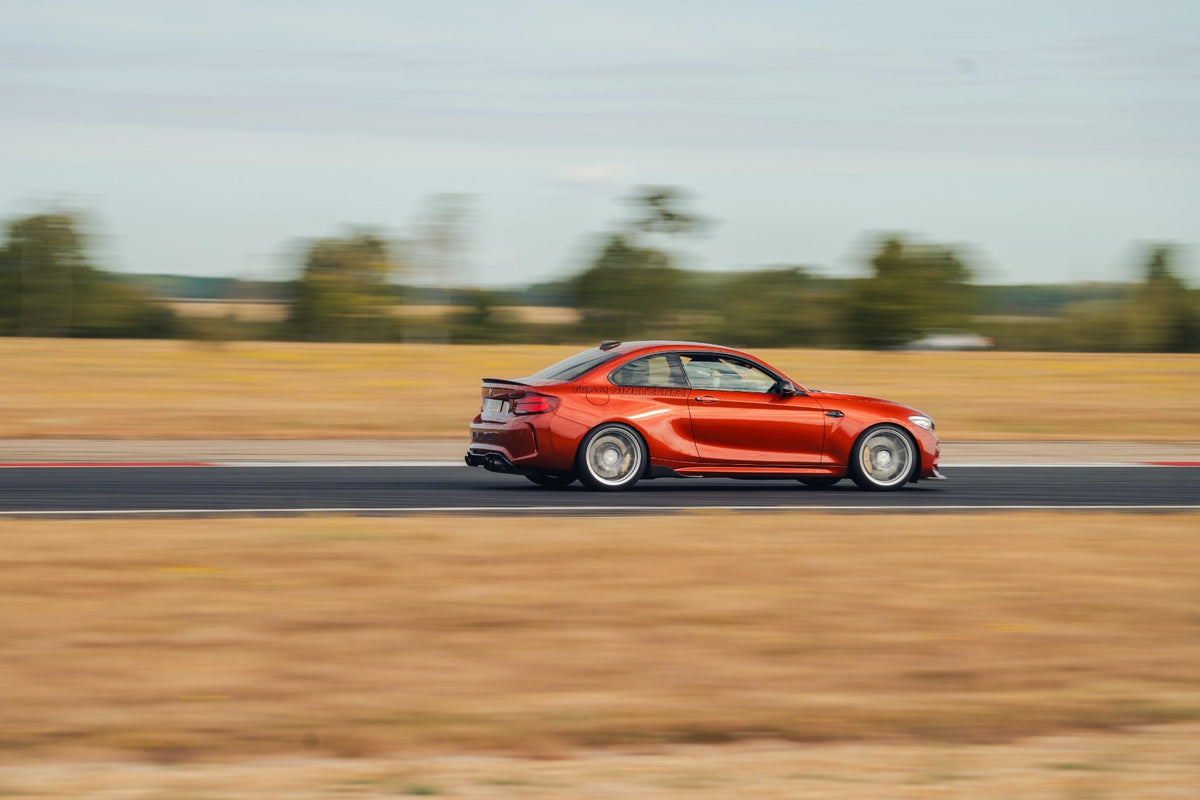
Nineteen72 Development Car · Bedford Autodrome
In March we brought our BMW M2 Competition to Bedford Autodrome in almost standard form. A few months later we returned to the same circuit with a completely different chassis underneath it. Same car. Same venue. A much better opportunity to understand what the modifications have actually changed.
August 2026 · Nineteen72 Performance

Before modifying the car, we needed a baseline
Our first trip to Bedford earlier this year was deliberately simple. At the time the M2 Competition was essentially a standard car wearing Eibach lowering springs and wheel spacers.
That was important. It gave us the chance to drive the car properly before deciding what needed changing. Rather than building an M2 from a list of popular parts, we wanted the weaknesses to reveal themselves through use.
Even in near-standard form the F87 is an extremely capable car, but a circuit quickly exposes things that are far less obvious on the road. Body movement, the time the chassis takes to settle after a direction change, drivetrain compliance and the demands placed on the brakes all become much clearer.
Baseline car
- BMW M2 Competition F87
- Factory dampers
- Eibach lowering springs
- Wheel spacers
- Predominantly standard chassis
- Road-focused setup
Development car
- Nitron R1 coilovers
- Corner weighted & aligned
- Powerflex chassis & drivetrain upgrades
- 2Forge wheels & Continental tyres
- Developed braking package
- Chassis-mounted front splitter
- M2 CS engine, DCT & differential calibration

The visual changes are obvious. The important ones are underneath.
Between the two Bedford visits the direction of the car changed significantly. It is still a full-interior road car and that remains a non-negotiable part of the brief, but the chassis is now much closer to what we originally wanted from the project.
The biggest change is the move from Eibach lowering springs on the standard dampers to a complete Nitron R1 coilover system. Around that we've addressed differential and transmission movement, front axle response, wheel fitment, braking consistency and airflow.
Nitron R1
Single-adjustable coilovers with 140 N/mm front and 90 N/mm rear main springs, built around control rather than simply making the car stiffer.
Powerflex
Dual differential mounting, upgraded differential bushes, transmission bushes and front control arm caster bushes reduce unwanted compliance.
2NH developed
Rebuilt factory calipers, dedicated road and track pad options, HEL braided lines, Motul RBF 700 and additional front brake airflow.

The difference appeared before we started chasing speed
Returning to the same venue was valuable because we already had a reference point. We knew what the car had felt like here in March and could concentrate on how the current package behaved rather than learning an entirely new venue.
The most obvious improvement is how quickly the car now settles. Where the old spring-and-standard-damper setup could take a moment to recover after a compression, braking input or fast direction change, the Nitron-equipped car feels substantially more controlled.
That doesn't simply make the car feel 'stiffer'. The more useful change is predictability. Steering input produces a cleaner response, weight transfer is easier to read and the car gives the driver more confidence to ask for another input before the previous movement has finished.
Same circuit, but a very different chassis underneath the car compared with our first Bedford visit in March.
Less movement
The body takes less time to settle after braking, compressions and rapid steering inputs.
Cleaner response
The front axle feels more directly connected and the initial steering response is easier to read.
More confidence
The value is not simply higher cornering speed. It is knowing more clearly what the car will do when another input is added.

The Nitron R1s changed the character of the car
Eibach springs had been a good first modification. They improved the stance and gave the standard car a slightly sharper road feel without turning it into something unpleasant to use.
Track use, however, showed us why springs alone were never going to be the final answer.
The Nitron R1 system gives us control of the damper as part of a complete package. Our recorded setup uses 140 N/mm front main springs, 90 N/mm rear main springs and 20 N/mm helper springs at both ends.
More importantly, it gives the project somewhere to go. Damper adjustment, alignment, ride height, tyre pressure and eventually tyre temperature can now be treated as parts of the same setup rather than isolated modifications.
Reducing compliance elsewhere
The dampers aren't working alone. The rear dual differential mount and upgraded differential bushes reduce movement under acceleration and abrupt load changes, while the transmission bushes make the connection through the drivetrain feel more immediate.
At the front, upgraded caster bushes contribute to a more direct axle response. These parts inevitably transmit more mechanical information into the car, but that's a compromise we're willing to accept while the M2 remains primarily a fast-road and track-day development car.

Faster is useful. Repeatable is more important.
One of the biggest changes in the philosophy of the build is that we no longer expect one component to perform every job.
The factory 2NH braking hardware remains because it is fundamentally a very capable system. All four calipers have been rebuilt and refinished, supported by HEL braided brake lines, Motul RBF 700 fluid and Genuine BMW race brake ducts integrated into the front bumper.
We also now have separate road and track pad configurations. That makes far more sense than trying to find a single compound which is quiet and friendly from cold on the road while simultaneously being ideal during repeated high-temperature circuit use.
The purpose of the Bedford day wasn't to invent a brake-temperature reduction figure or claim a percentage improvement without instrumentation. It was to continue building a package that can be measured properly as the car develops.

Parts created the platform. Setup made them work together.
Between the two Bedford visits, the M2 was also corner weighted and aligned. The recorded total weight is 1,732 kg with a 50.01% cross weight.
The more interesting part of the alignment wasn't simply adding negative camber. The original rear toe values were heavily mismatched from side to side. Correcting those values produced a symmetrical rear setting and a neutral recorded thrust angle.
That's representative of how we want to approach the whole build. A dramatic headline number isn't automatically better. A car that responds consistently left and right and gives predictable tyre behaviour is far more useful.
Alignment
- LF camber: −1.883°
- RF camber: −1.583°
- LF caster: 7.517°
- RF caster: 7.317°
- Toe: 0.083° per side
Alignment
- LR camber: −1.550°
- RR camber: −1.517°
- LR toe: 0.133°
- RR toe: 0.133°
- Thrust angle: 0.000°
More performance without chasing a dyno headline
Mechanically, the S55 remains close to standard. The development so far has concentrated on the chassis rather than building a high-output engine.
The car now runs BMW M2 CS engine software along with the CS DCT and differential calibrations. That suits the project: a modest development of the factory package rather than turning the car into something dominated by power.
Because the differential software and mechanical rear mounting changes were introduced during the same stage of development, we're not pretending we can separate their individual contribution without proper back-to-back testing. What matters for now is that the complete drivetrain feels more connected than it did during the March baseline.
Bedford had a seriously good BMW paddock
Track time was the reason for being there, but half the appeal of days like this is what happens between sessions.
The paddock covered several generations of BMW performance cars, from E46 M3s through F-series M cars and newer G87 M2s. More interestingly, almost every car represented a different interpretation of what a track-capable BMW should be.
Some were lightly modified road cars. Others had cages, wings, buckets and much more serious circuit hardware. Walking around the paddock, talking to owners and seeing how other people have solved the same problems is part of what makes these events worthwhile.
March was the baseline. This was version two.
The biggest lesson from the second Bedford visit is that the car is moving in the right direction.
The first visit felt like taking a very good road car onto a race circuit. This time the M2 felt like a road car that has started to be genuinely developed for circuit work.
That's an important distinction because we're still not trying to build a stripped-out race car. The M2 retains its interior, road equipment and the usability that made us want to develop this platform in the first place.
What has changed is the level of control underneath it. The suspension gives us a proper platform to work from, the drivetrain feels better tied down, the braking system has been developed around repeatability and the car's alignment now gives us a consistent starting point.
Where the development goes next
The next stage is less about replacing major components and more about learning how to use what is already fitted.
Damper settings, tyre pressures, tyre temperatures, shoulder wear, brake temperatures and alignment will give us more useful information than simply adding another part to the car.
Future track days will therefore become increasingly data-led. If something works, we'll document it. If something doesn't, we'll document that too.
Track, paddock and the people behind the day


A selection of photographs from our latest visit to Bedford Autodrome.
Develop your own M2
Building an F87 M2 Competition for fast-road or track use?
Many of the components fitted to our own development car are available through Nineteen72 Performance. The important part isn't fitting every modification at once — it's choosing the parts that suit how the car is actually going to be used.
