
Choosing coolant should be a specification decision, not a colour decision. That matters on any car, but it becomes especially important on modern BMW, Porsche, Audi, Volkswagen and Toyota cooling systems, where different inhibitor packages, materials and manufacturer approvals can sit behind bottles that look deceptively similar.
The wrong product may not cause an immediate failure. The bigger risk is reduced corrosion protection, deposits, seal compatibility problems or a mixture that no longer performs as its manufacturer intended. This guide explains how to choose the right coolant for your car, when to use ready-mixed or concentrated antifreeze, what to do if the existing fluid is unknown, and where cooling additives fit into a road or track car.
Quick answer: check the vehicle handbook, expansion-tank label, manufacturer specification or VIN-based parts data. Match the required specification exactly. Do not select coolant by colour alone, and do not mix products unless compatibility is explicitly confirmed.
What does car coolant actually do?
Coolant circulates through the engine, cylinder head, radiator, heater matrix and, on many modern performance cars, additional cooling circuits. It has several jobs:
- Carry heat away from the engine and other temperature-sensitive components.
- Protect the system from freezing in cold weather.
- Raise the boiling margin compared with plain water when used in the correct pressurised system.
- Protect aluminium, iron, copper, solder and other materials from corrosion.
- Help protect seals and the water pump when the approved formulation is used.
- Limit deposits, cavitation and scale that can reduce cooling efficiency.
For a performance car, cooling-system health is not only a winter concern. A road car in traffic, a tuned turbocharged engine and a car working hard on circuit can all expose weak coolant, trapped air, blocked radiators or failing components very quickly.
Are coolant and antifreeze the same thing?
The terms are often used interchangeably, but the wording on the bottle matters. Antifreeze concentrate is normally a glycol-based product with a corrosion-inhibitor package that must be diluted correctly. Ready-mixed coolant is already blended with water at the stated ratio and is intended to be poured in without further dilution.
A concentrated antifreeze is not automatically better. Used neat, it can transfer heat less effectively than the correct water and antifreeze mixture. Ready mix removes the guesswork, while concentrate is useful when you need to control the final ratio or when residual water remains after flushing the system.
Why coolant colour is not a reliable fitment guide
Blue, green, red, pink, purple and yellow fluids are easy to identify in a bottle, but colour is not a universal technical standard. Different manufacturers can use similar dyes for different formulations, while products with related chemistry can appear in different colours.
The specification, approval and application are what count. Coolant manufacturer GLYSANTIN states that individual coolant technologies are not necessarily compatible and should be selected for the relevant engine or cooling-system technology. That is why matching by colour, or topping up with whatever looks similar, is risky.
If you know the exact product already in the car, use the same approved product. If you only know the colour, check the service history, handbook, reservoir label or manufacturer data before adding anything.
How to choose the right coolant for your car
1. Find the required manufacturer specification
Start with the owner’s handbook or official service information. Look for a specification or approval, not just a general description such as “long-life coolant”. Examples can include a manufacturer code, an OEM part number or a recognised coolant standard.
If the information is unclear, use the VIN. Model names are not always enough because the approved coolant can change by production date, engine, market or cooling-system revision.
2. Check the product label and technical data
A suitable bottle should list the standards, approvals or recommendations it meets. “Suitable for modern cars” is not a substitute for the exact requirement.
For example, LIQUI MOLY lists KFS 12 Evo against specifications including BMW LC 18, BMW LC 87, BMW LC 97 and Volkswagen TL 774-L, also known as G12 Evo. That does not make it a universal coolant. It means it can be considered where the vehicle manufacturer requires one of the specifications the product explicitly covers.

3. Decide between ready mix and concentrate
| Option | Best suited to | Important point |
|---|---|---|
| Ready-mixed coolant | Simple top-ups and straightforward drain-and-refill servicing | Use as supplied unless the manufacturer says otherwise |
| Concentrated antifreeze | Full system fills where the final concentration is being controlled | Dilute using the product instructions and suitable water |
| Cooling additive | Specific performance or competition applications | May provide no frost protection and may not replace normal coolant |
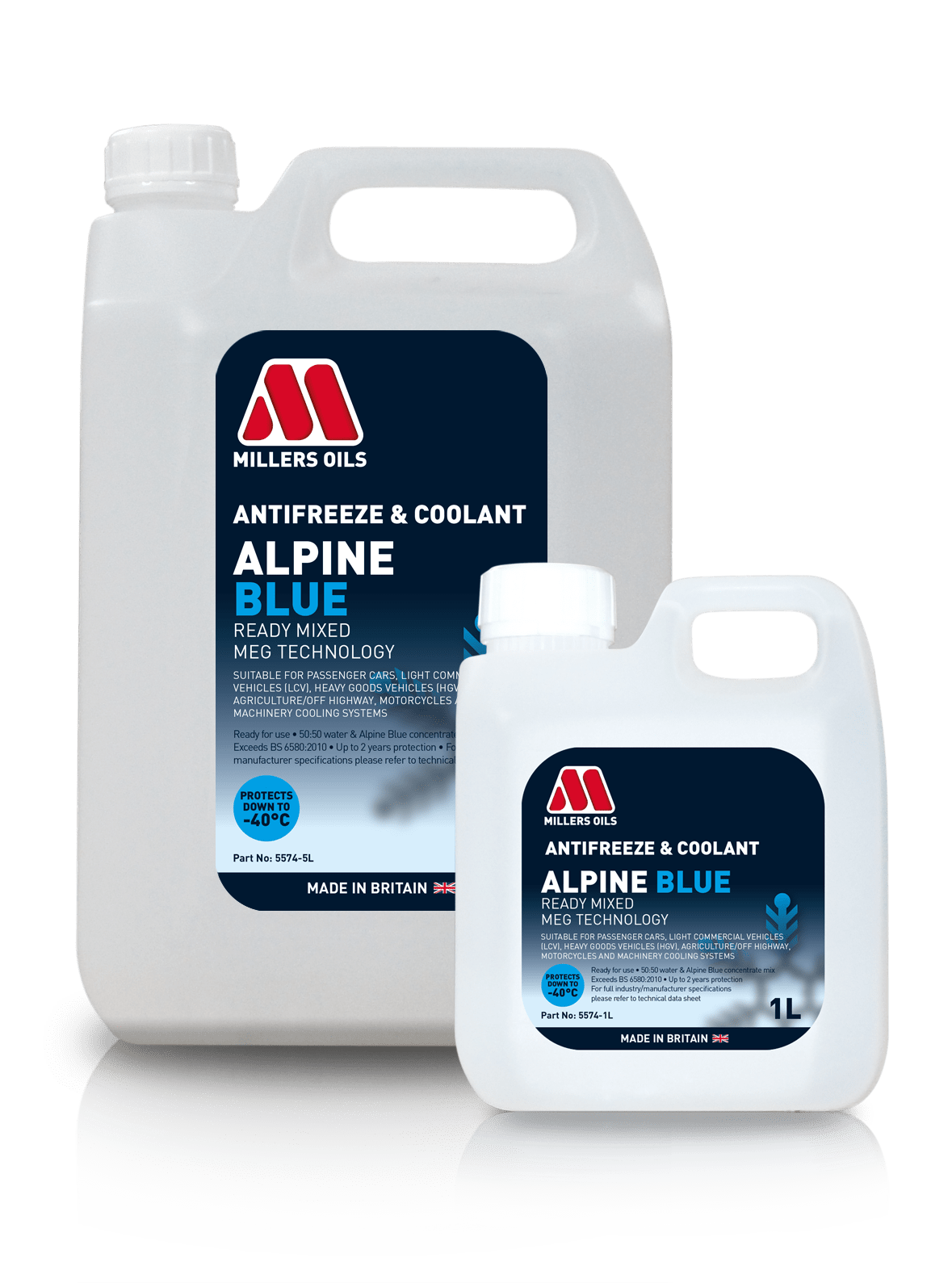
Millers Alpine Blue Ready Mixed, for example, is supplied as a 50:50 premix. Millers states that it uses Inorganic Acid Technology and provides freeze protection down to -40°C. It should still only be used where that formulation matches the vehicle requirement.

4. Identify what is already in the system
If the existing fluid is known and correct, topping up with the same product is usually the simplest route. If it is unknown, contaminated or clearly mixed, a proper drain, flush and refill is safer than building another layer of guesswork into the system.
Never open the expansion tank when the engine is hot. The cooling system can remain pressurised and hot coolant can cause serious burns.
5. Check the fill quantity and bleeding procedure
Buying the correct coolant is only part of the job. Cooling-system capacity varies, and some modern cars have multiple circuits or an electric bleeding routine. Air trapped in the system can cause poor heater performance, unstable temperatures and localised hot spots.
Use the manufacturer’s fill and bleed process. If the vehicle has recently overheated, lost a large amount of coolant or repeatedly needs topping up, find the fault before treating the refill as normal maintenance.
What are IAT, OAT and hybrid coolants?
These terms describe broad inhibitor technologies rather than a complete fitment answer.
- IAT: Inorganic Acid Technology, commonly associated with some older applications and shorter traditional service intervals.
- OAT: Organic Acid Technology, developed for longer-life corrosion protection in many later vehicles.
- HOAT, Si-OAT and related hybrids: formulations that combine inhibitor approaches to meet particular manufacturer requirements.
Those labels help explain why coolants differ, but two products from the same broad family are not automatically interchangeable. The exact approval still wins.
Can you mix different coolant types?
Only when the manufacturers explicitly confirm compatibility with the specifications involved. Mixing incompatible inhibitor packages can reduce corrosion protection or create deposits. Even where two products are described as miscible, the resulting mixture may not retain the full service life or approval of either original fill.
For an emergency top-up, follow the vehicle manufacturer’s guidance. A small quantity of suitable water may be preferable to an unverified coolant on some vehicles, but it changes freeze protection and concentration. Treat that as a temporary measure, then test or renew the coolant correctly.
BMW blue coolant vs green coolant
BMW owners regularly search by colour, but BMW coolant requirements have changed across generations and production dates. A blue fluid seen in one car does not prove that every BMW should use blue coolant, and a current green Genuine BMW product is not automatically correct for every older model.
Nineteen72 stocks Genuine BMW Green Coolant Antifreeze, part number 83195A42DF3. Confirm the part number or required BMW specification against the VIN before ordering. If in doubt, ask for a VIN check rather than relying on the model badge or coolant colour.
What about Audi, Volkswagen, Porsche and Toyota coolant?
The same rule applies across VAG and Toyota applications. Terms such as G12+, G12++, G13 and G12 Evo refer to specific Volkswagen coolant standards, not a simple colour hierarchy. Some aftermarket products carry multiple stated recommendations or backward-compatibility claims, but these should be checked against the vehicle requirement and the product manufacturer’s own data.
Porsche and Toyota applications can also vary by model, engine and year. Avoid assuming that a coolant is correct because it works in another car from the same group or because the bottle mentions a broad make. Use the specification first, then choose the matching product and quantity.
Road and track coolant: where additives fit
A track car still needs a sound cooling system, the correct fill level and an appropriate coolant strategy. A cooling additive cannot compensate for a damaged radiator, failing water pump, air lock, collapsed hose, poor ducting or an engine calibration that creates excessive heat.
Motul MoCool is a cooling-system additive aimed at applications where overheating is observed or in racing conditions. Motul explicitly states that MoCool provides no antifreeze protection. It should not be treated as a direct replacement for winter-capable road coolant, and circuit regulations should be checked because some organisers restrict coolant additives.

Signs your coolant system needs attention
- The coolant level keeps falling after it has been set correctly.
- The fluid is cloudy, rusty, oily or contains visible deposits.
- There is sludge around the expansion tank or cap.
- The heater output changes unexpectedly.
- The temperature rises in traffic or during sustained load.
- There are dried coolant traces around hoses, the radiator, expansion tank or water pump.
- The service history does not confirm what fluid is in the car.
Do not simply keep topping up a system with an unexplained loss. Pressure testing and a proper inspection can prevent a minor leak from becoming an overheating event.
Car coolant buying checklist
- Confirm the vehicle, engine and production date.
- Find the required manufacturer specification or OEM part number.
- Check whether the product is ready mixed, concentrated or an additive.
- Verify compatibility with the coolant already in the system.
- Calculate the correct system quantity.
- Follow the manufacturer’s fill and bleeding procedure.
- Dispose of old coolant responsibly. It is toxic and must not be poured down a drain.
You can browse the Nineteen72 Performance coolant and antifreeze range, including Genuine BMW, Millers Oils, LIQUI MOLY and Motul products. If fitment is unclear, contact us with the registration and VIN so the required specification can be checked before purchase.
Frequently asked questions
What coolant does my car need?
Use the specification in the handbook, official service data, reservoir label or VIN-based parts information. Do not choose by colour alone.
Can I mix blue and green coolant?
Colour does not prove compatibility. Only mix products when their manufacturers confirm that the specifications and technologies are compatible. If the existing fluid is unknown, a controlled flush and refill is the safer option.
Can I use plain water instead of coolant?
Plain water does not provide the same freeze, corrosion and system protection as the correct coolant mixture. It may be used only as an emergency measure where the vehicle manufacturer permits it, followed by a proper refill as soon as possible.
Is ready-mixed coolant better than concentrate?
Neither is universally better. Ready mix is convenient and removes dilution errors. Concentrate gives control over the final mixture when used with the correct water and manufacturer instructions.
How often should coolant be changed?
Follow the vehicle manufacturer’s interval and the approved coolant’s service requirements. The interval varies by vehicle and coolant technology. Replace it sooner if contamination, an incorrect mixture or cooling-system repairs make that necessary.
Can I use a track coolant additive on the road?
Check the product instructions, required coolant system, climate and event rules. Some additives provide no antifreeze protection, so they cannot replace an appropriate year-round road coolant in UK winter conditions.

