
If you modify the suspension on a BMW M2, M3 or M4, geometry quickly becomes just as important as the springs or dampers themselves. Lower ride height, additional camber and more aggressive fast-road or track settings can all move the rear suspension away from the range that BMW intended for a standard road car.
72Racing is our performance parts range built around that problem. The current BMW range focuses on adjustable rear suspension links for F8X and G8X M cars, giving owners and alignment technicians more control over toe, camber and the remaining rear link positions when building a more focused setup.
You can browse the full range in the 72Racing collection.
Why adjustable rear arms matter on a modified BMW
BMW gives the factory suspension a useful amount of adjustment, but the available window is designed around standard ride height, standard bushes and a road-biased alignment. Once the car is lowered or the target geometry becomes more aggressive, the standard links can become the limiting factor.
Rear toe and camber are closely linked to how the car behaves under braking, corner entry, mid-corner load and acceleration. More adjustment does not automatically mean a better setup. The advantage is that the technician has a wider range available to achieve the geometry the car actually needs.
That is particularly relevant on cars running coilovers, lowering springs, increased negative camber, wider tyres or regular track use.
72Racing adjustable rear toe arms
The 72Racing Adjustable Rear Toe Arms replace the corresponding factory rear link with an adjustable pair.
Toe has a major influence on rear-axle stability and response. A small change can alter how securely the car tracks in a straight line, how readily it rotates on turn-in and how settled it feels when the rear axle is loaded under power.
On a lowered BMW M car, rear toe also needs to be considered alongside camber. Chasing one setting without checking the other can leave the final alignment compromised. Adjustable toe arms give the alignment technician additional scope to set the rear axle accurately rather than accepting whatever remains within the factory range.

72Racing adjustable rear camber arms
Rear camber becomes increasingly important as tyre width, ride height and cornering load increase. More negative camber can help maintain tyre contact during cornering, but too much can compromise braking, straight-line traction and tyre wear.
The 72Racing adjustable rear camber arms are intended to give additional adjustment range so the final figure can be selected around the car's actual use rather than simply dictated by the standard suspension hardware.
For a road car, the target may remain relatively conservative. For a fast-road or track-focused car, the technician may choose a more aggressive setting depending on tyre choice, spring rate, circuit use and driver preference.

72Racing traction / caster arms
The rear suspension is a multi-link system, so toe and camber are only part of the complete geometry picture. The matching 72Racing traction / caster arms allow the remaining rear link position to be upgraded as part of a more complete package.
This is useful for owners who want the rear axle to be set up as a system rather than replacing a single arm in isolation. The aim is not simply to add adjustability everywhere. It is to give the alignment process enough control to produce repeatable settings across the rear axle.

The 72Racing complete six-arm rear kit
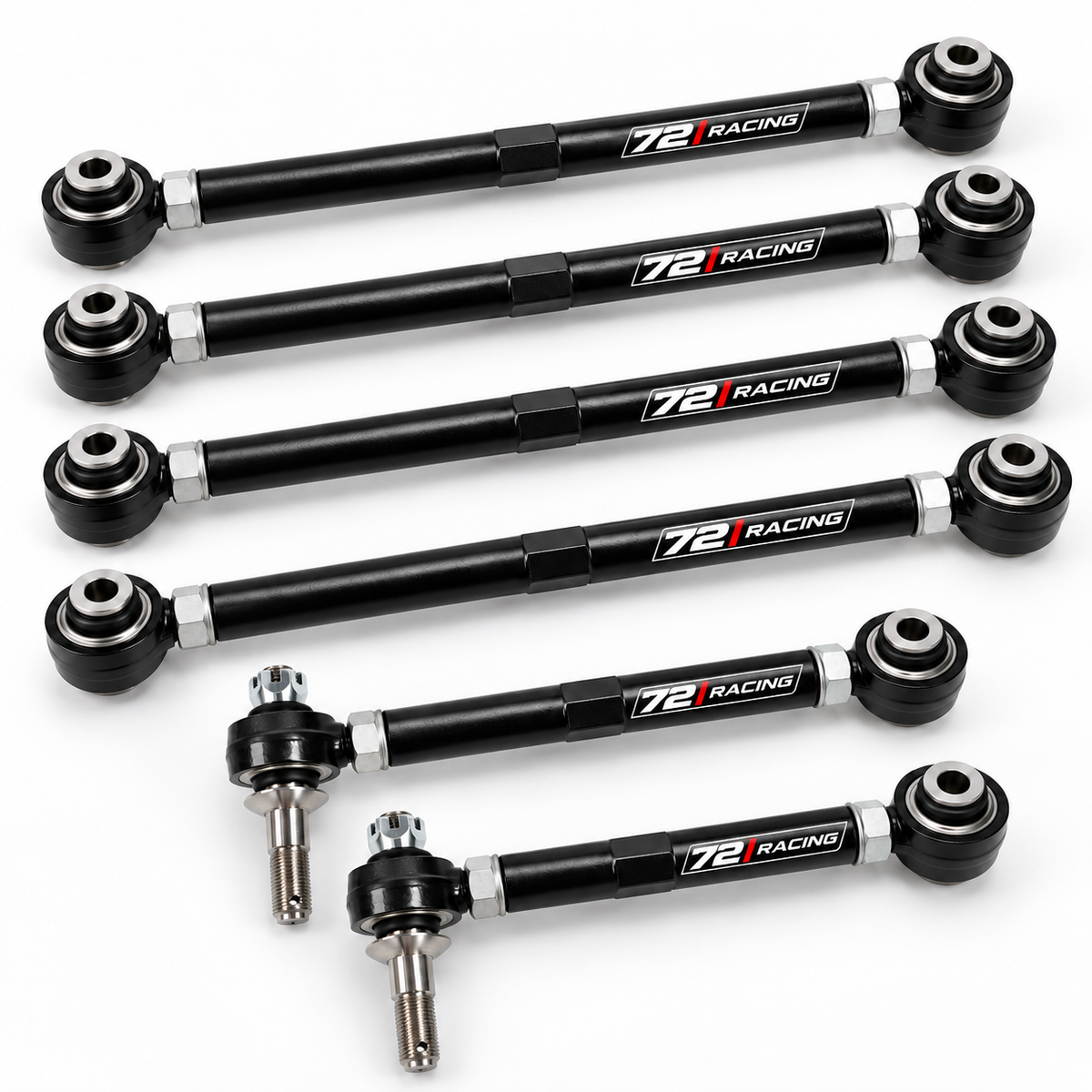
For owners building a complete rear geometry package, the 72Racing six-arm kit combines the matching adjustable rear links into one package.
This route makes the most sense when several factory links are already being replaced, when the car is being prepared for repeated track use, or when the owner wants a consistent family of components across the rear axle.
It also creates a clearer path for the alignment technician because toe, camber and the additional rear link positions can be approached as one setup rather than a collection of unrelated parts.

BMW fitment: F87, F80, F82, G87, G80 and G82
The current 72Racing suspension range is aimed at BMW M2, M3 and M4 platforms across the F8X and G8X generations, including:
- BMW F87 M2 and M2 Competition
- BMW G87 M2
- BMW F80 M3
- BMW G80 M3 and G81 M3 Touring
- BMW F82 and F83 M4
- BMW G82 and G83 M4
Always check the individual product page before ordering because the exact suspension position and corresponding BMW component should be confirmed for the vehicle.
72Racing vs Hardrace, Millway and Suspension Secrets
BMW owners now have several credible routes when upgrading rear geometry. Hardrace, Millway Motorsport, Suspension Secrets and 72Racing all approach the problem from slightly different product ranges and construction choices.
Hardrace offers adjustable rear camber and toe solutions across many BMW applications. Millway is well known for billet suspension components and Uniball-based products, while Suspension Secrets combines individual suspension components with vehicle-specific handling and kinematics packages. 72Racing currently takes a more focused modular approach around the key adjustable rear links for F8X and G8X M cars.
There is no universal best answer because the right choice depends on the car, intended use, bearing or bush preference, required adjustment range and budget. We already cover the differences between two of the established options in our Hardrace vs Millway BMW Geometry Arms guide, and we will continue expanding those comparisons as the 72Racing range develops.
Road, fast-road or track geometry?
The hardware is only one part of the result. A car with expensive suspension components and poor geometry can drive worse than a standard car with a careful alignment.
For road use, stability, tyre life and predictable behaviour normally take priority. A fast-road setup can add sharper turn-in and improved tyre support without making the car unpleasant on longer journeys. Track-focused geometry can move further again, but should be matched to the tyre, suspension, circuit and driver.
The important part is to decide how the car will actually be used before choosing the final settings.
Do you need adjustable arms after lowering?
Not every lowered BMW automatically needs every adjustable arm. A modest drop may still align correctly on the factory hardware. The case for adjustable links becomes stronger when:
- the desired toe or camber cannot be achieved within the factory range;
- the car runs a more aggressive track alignment;
- ride height has changed significantly;
- wider wheels and tyres require more precise geometry control;
- the owner wants greater repeatability between road and track setups.
The sensible approach is to measure the car, understand the target settings and then fit the components that solve the actual limitation.
What should be done after fitting adjustable suspension arms?
Professional installation should always be followed by a full four-wheel alignment. The new adjustment range is only useful if it is measured and set correctly.
It is also worth checking fasteners and alignment settings after the car has covered some mileage or completed a track day, particularly when multiple suspension components have been changed at the same time.
Shop 72Racing BMW performance parts
The 72Racing range will continue to develop around BMW performance, suspension and chassis applications. The current catalogue includes adjustable rear suspension components for F8X and G8X M cars alongside equal-length exhaust solutions for S55 and S58 applications.
Shop all 72Racing performance parts or contact Nineteen72 Performance if you need help confirming fitment or choosing the right combination for your BMW.

